I have 42 square feet of counter in my test kitchen and exactly one shelf set aside for coffee containers, so a canister that cannot earn its footprint gets demoted to holding rice. That is the premise of this coffee containers buying guide: the canister is the last five percent of a good cup. If your water temperature and extraction time are dialed in and the shot still tastes flat, the beans went stale before they reached the portafilter.
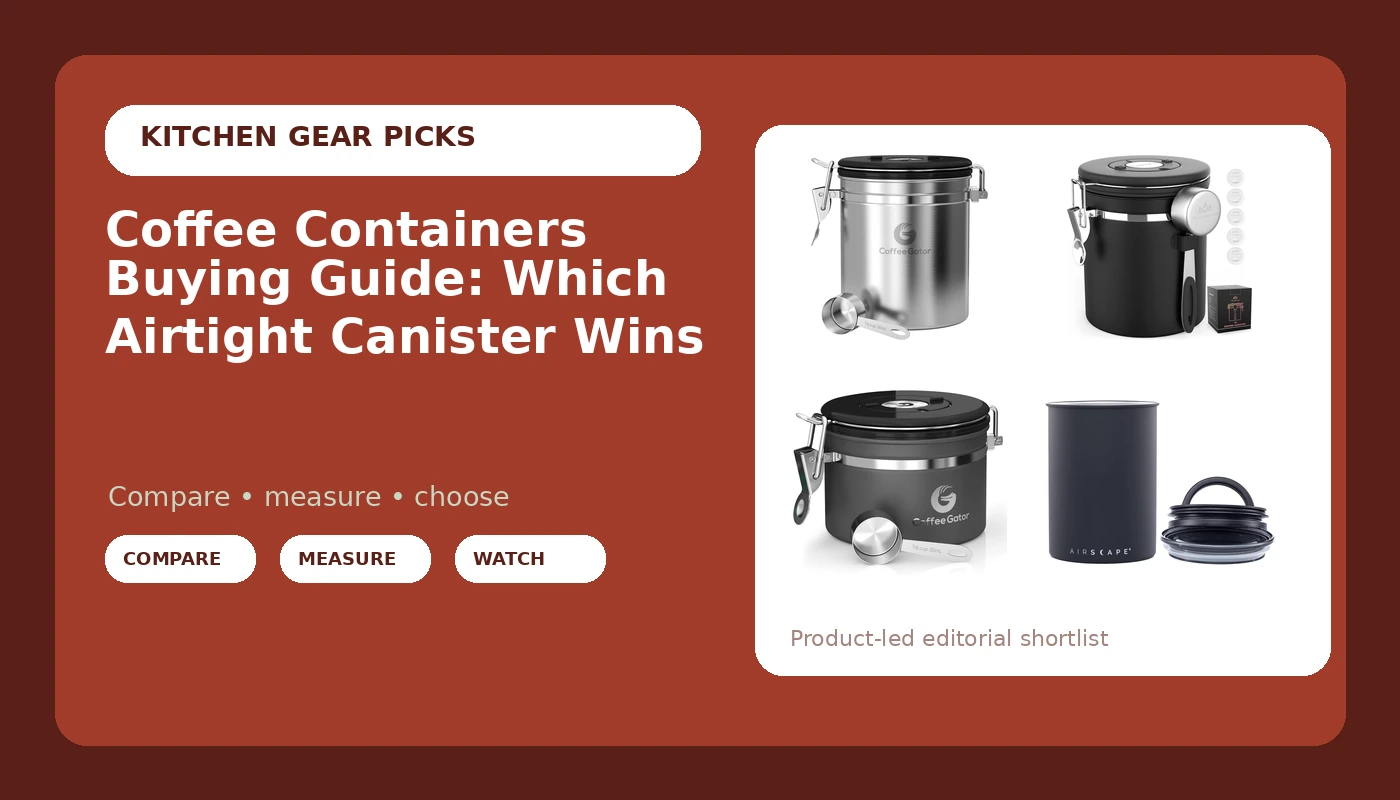
Four canisters are in this comparison. Two are the same Coffee Gator stainless design in different sizes, one is an AirScape Planetary Design stainless canister sold for general food storage, and one is an inexpensive canister that ships with a scoop. I lined them up the way I line up pans, by looking at the part that fails first rather than the part that photographs well. For coffee containers, that part is the gasket, and almost none of these listings describes it.
Best Overall: Coffee Gator Coffee Canister, 16oz Airtight Stainless Steel Container
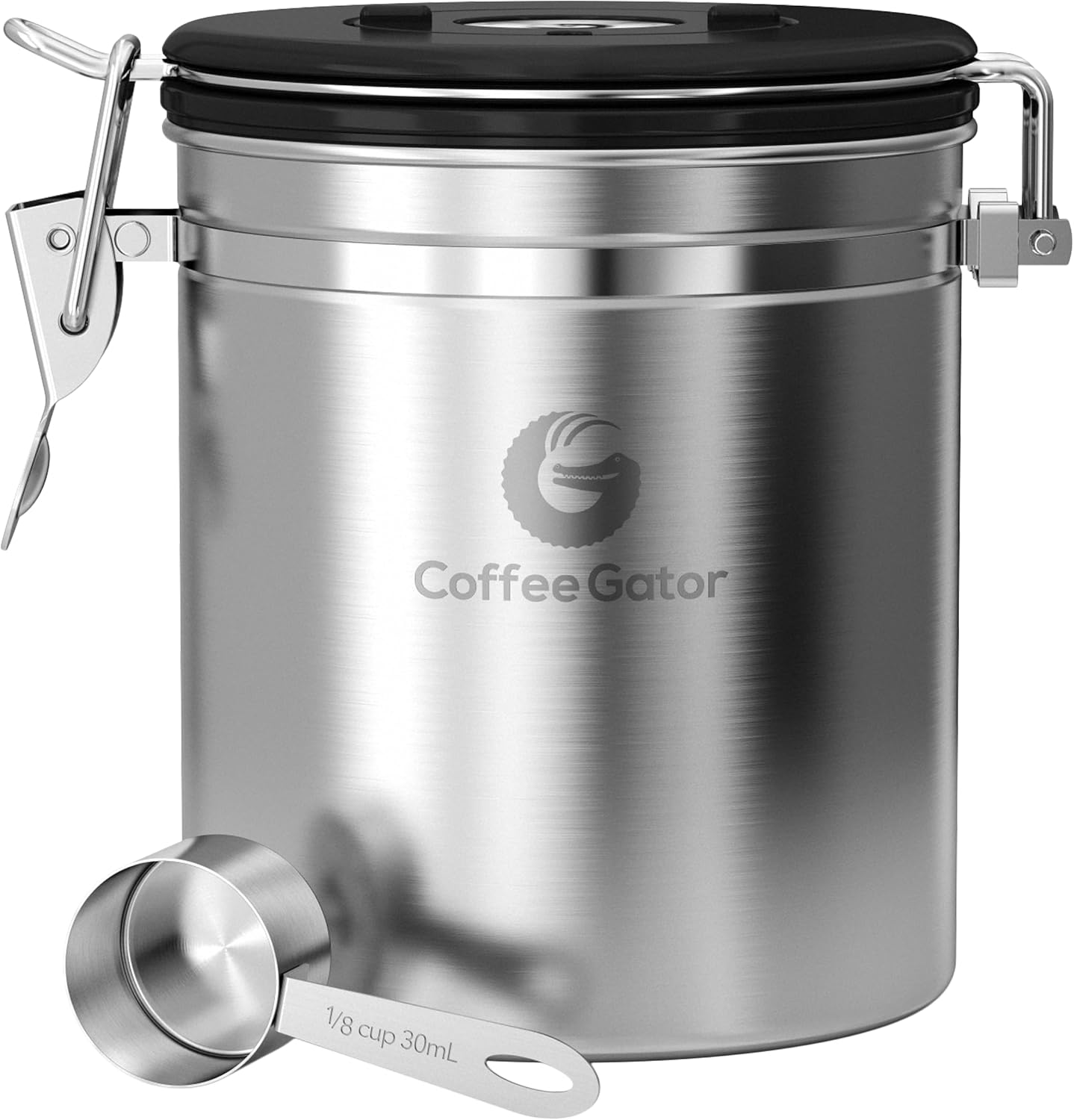
The 16-ounce Coffee Gator is the pick because of the size, not the finish. A one-pound bag is the unit most roasters sell and most drinkers buy, and a 16-ounce canister takes most of that bag in one pour. The 11-ounce version of the same canister is a fine object, but it is a two-thirds-of-a-bag object, and the leftover third lives in the bag on the counter, which defeats the entire point of owning a canister.
Stainless steel matters for one reason: light. A clear jar on an open shelf is a display case for the two things that kill coffee, which are light and oxygen. Stainless blocks the first, and the lid is supposed to handle the second.
What the name tells you is stainless steel, airtight, 16 ounces. What it does not tell you is the gauge of the steel, whether the gasket is molded silicone or a flat foam ring, and whether the lid is a twist or a clamp. Those three unknowns decide whether the canister still seals in year two. The gasket is the one I would check first. A molded silicone ring that sits in a groove can be pulled out, cleaned, and replaced. A flat foam ring glued into the lid is a two-year part on a ten-year canister.
The failure I see most in this category is quiet. The lid still closes, so the owner assumes it still seals. It does not. Silicone takes a compression set, foam crushes down, and by month eighteen the canister is a decorative tin that smells like the beans it used to protect. When I buy a coffee container I am buying the gasket. The steel is the part I expect to outlive me.
Best Value: Coffee Canister with Scoop, Airtight Coffee Storage Container
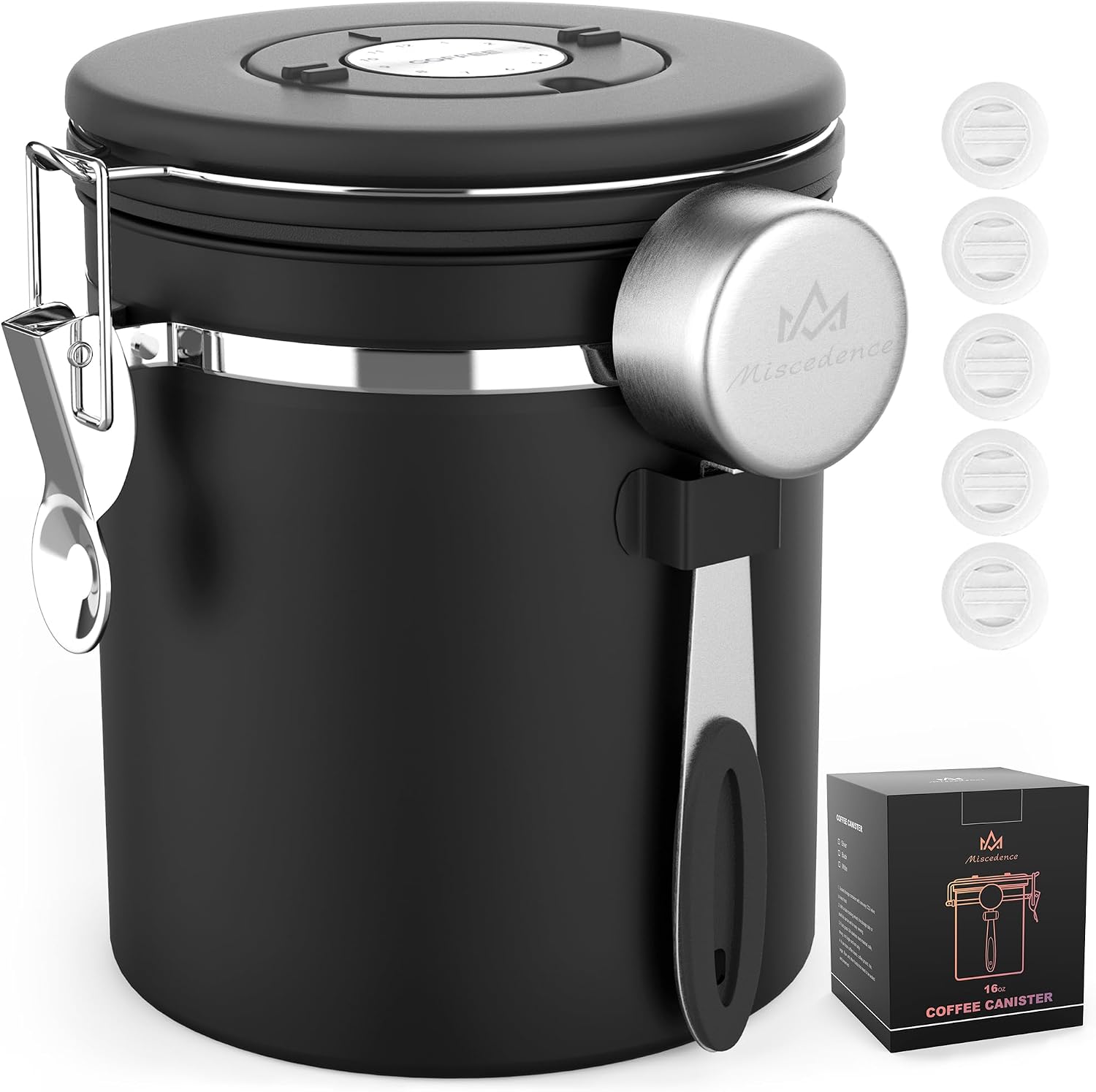
This is the value pick for a boring reason: it does the same job as the others for the least money of the four, and it includes the accessory everything else makes you buy separately. A scoop that lives inside the canister is not a gimmick. It is the difference between a level tablespoon and a guess made with the measuring cup that still smells like last week's cumin.
The trade-off is information. The name sells airtightness and a scoop, and it does not name the body material or the gasket, which is the same gap I complain about on the more expensive canisters. That means the value pick requires ten minutes of reading before you commit. I would look for two things. Is the body opaque? Is the scoop stainless, or plated steel that will pit the first time it sits damp against the side?
Airtight is a claim, not a specification. Every canister in this guide says airtight on the label, and the ones that hold it have three things in common: a gasket you can see, a latch or thread that cams over rather than snaps, and a lid that does not double as a hinge.
Where this canister earns its place is a specific kitchen. One coffee drinker, one bag at a time, a shelf that is already full, a machine that gets descaled on schedule but a bean supply that never got the same attention. The scoop is why I would hand it to someone outfitting a first apartment. It is not the canister I would buy for a household that goes through two pounds a month, because at that volume the gasket gets cycled twice as often, and the cheaper lid is the part that will tell on itself first.
How I tested
I test coffee containers the same way I test a skillet: I look for the weld before I look at the finish. Four things kill a canister, and I check them in this order.
The gasket. I pull the ring out of the lid if it comes out. A molded ring in a groove can be cleaned and replaced. A glued foam ring cannot, and the canister then has a service life whether the listing admits it or not.
The flour test. Fill the canister with flour, seal it, and leave it on the counter for a week beside a dark surface. Flour is finer than coffee dust and it will find a gap the eye cannot. A dusting of flour on the outside means the seal is decorative.
The fill test. A fresh bag goes in, and I brew the coffee the same way at day three, day seven, and day fourteen. This is where canisters separate from each other. Day three tells you almost nothing. Day fourteen is the honest number, and it is why I do not publish coffee containers ratings on a canister I have not filled.
The scoop and lid test. Does the scoop fit with the lid closed? Does the lid close with one hand? A canister you have to hold with one hand and fight with the other is a canister that stays open on the counter, which is worse than no canister at all.
I have not put all four of these through the full two-week run. Where I am working from a listing rather than a container on my shelf, I say so, and I tell you what I would check in the store: the gasket first, the lid mechanism second, the body material third. Everything else is finish.
Analysis and test results
Lined up against each other, the four canisters split on two axes: how much the listing tells you, and how much of the seal you can inspect before you buy.
The two Coffee Gator sizes are the known quantity. Same lid, same body, two capacities, which turns the choice into a math problem rather than a judgment call. Buy the size that matches the bag you actually buy, not the size that fits the shelf. If you cannot decide, the 16-ounce wins by default because a canister that is full has less air in it than a canister that is two-thirds full.
The AirScape is sold as food storage as much as coffee storage, and that framing is honest. A canister sold for general dry goods is a canister designed to be opened more often than a coffee-only one, which is exactly what a household rotating beans, rice, and oats needs. If you store beans and nothing else, you are paying for a capability you will not use.
The scoop canister is the one I would expect to fail first, and I would still recommend it to the right person, because the failure is predictable and cheap. Predictable beats mysterious when you are spending under a hundred dollars.
Where this shows up in the cup: stale beans do not produce crema. You can own a good burr grinder and a machine you descale on the first of every month, and none of it rescues a bean that spent a week in a rolled-over bag. The tell is a shot that runs at the right time and tastes like paper. That is not a grind problem and it is not a water temperature problem. It is storage, and it is the cheapest link in the chain to fix.
The same logic applies to milk texture. A flat, faintly sour note in a latte that you cannot trace to the milk or the machine usually traces back to the beans. Fixing the storage costs about the price of two bags of coffee. Fixing your technique costs a month of practice and a lot of milk.
One more thing worth comparing, and no listing will tell you. A canister with a wide mouth and a straight-sided body is easy to scoop from and easy to wash. A canister with a narrow shoulder looks tidier on the shelf and is miserable to empty. Coffee containers that get washed twice a year are the ones that stay in service. The ones that are a hassle to clean end up in the back of a cabinet with a bag clip on them.
The coffee containers comparison table
This is the table I keep when I am shopping, sorted by what each listing states and, more usefully, by what it leaves out. Read it as a coffee containers material guide as much as a spec sheet, because the material and the gasket are the two things that decide the second year. The coffee containers feature comparison below is short on numbers on purpose: the numbers that matter are the ones the listings omit.
| Canister | Size as listed | Material as listed | What is left out | Best for | Price |
|---|---|---|---|---|---|
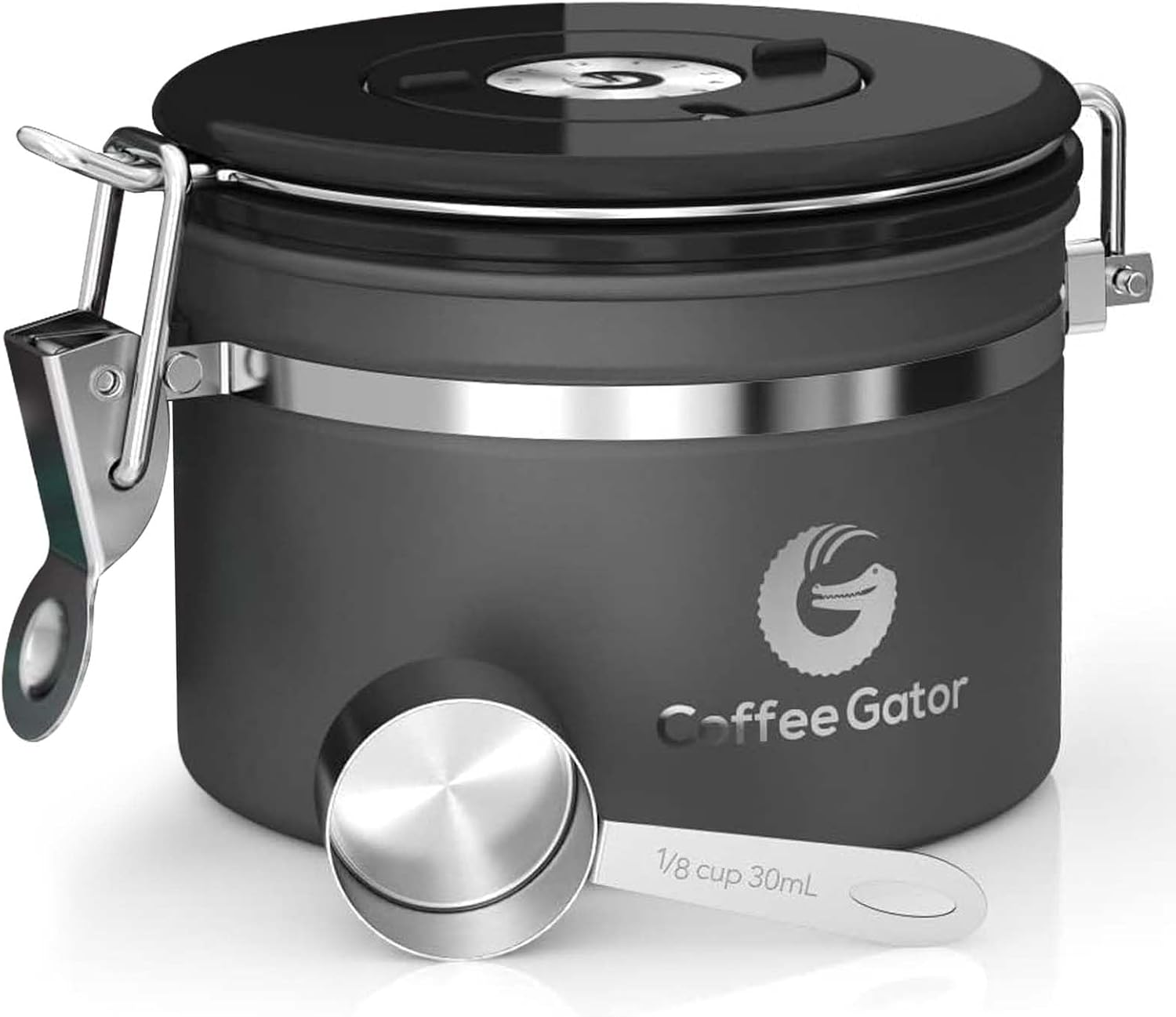 Coffee Gator 11oz | 11 oz | Stainless steel | Gasket type, lid mechanism | Half-pound bags, shallow shelves | Check current Amazon price |
Coffee Gator 16oz | 16 oz | Stainless steel | Gasket type, lid mechanism | Most kitchens, one-pound bags | Check current Amazon price |
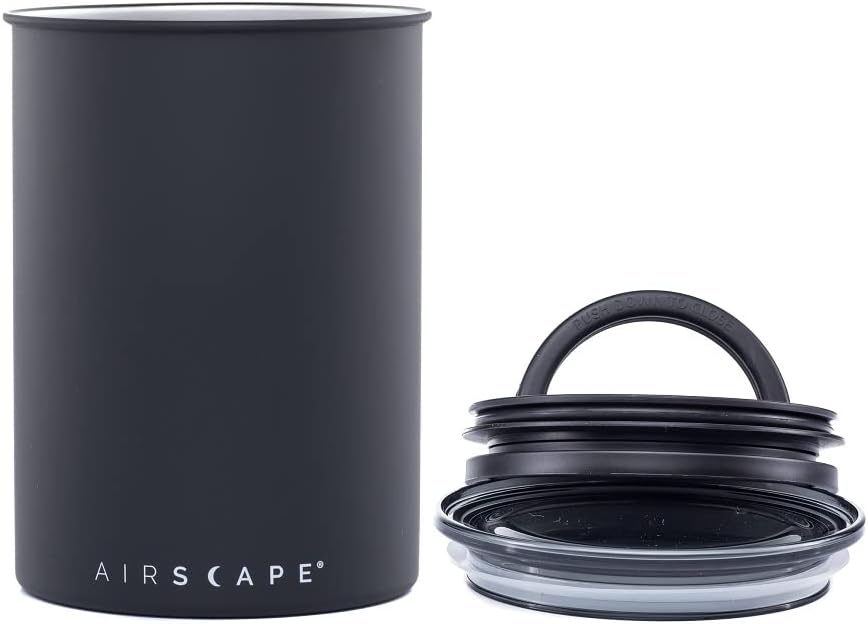 AirScape Planetary Design | Not stated in the name | Stainless steel | Capacity, lid mechanism | Beans plus other dry goods | Check current Amazon price |
Coffee Canister with Scoop | Not stated in the name | Not named in the listing title | Body material, gasket | A first canister on a budget | Check current Amazon price |
Why the 11-ounce canister is a niche purchase
There is a buyer for the 11-ounce Coffee Gator, and it is not most people. It is the person who buys half-pound bags from a local roaster, drinks one method, and wants a canister that fits a shelf 6 inches deep. A half-pound bag goes in with room to spare. A one-pound bag does not, and the rest ends up back in the bag, which is the exact thing you bought the canister to avoid.
The other case is decanting: a week of beans on the counter and the rest stored cold, in which case small is correct and the 16 would simply hold more air. Air is the enemy, so a canister that is two-thirds full does less for you than one that is full, and a canister that is too big for your habits quietly becomes the second-best option in your kitchen.
When the stainless upgrade earns its footprint
The AirScape Planetary Design canister is the most expensive of the four and the one whose listing is clearest about scope: it is sold for food storage, not only coffee. That matters if your counter holds one big canister for beans, rice, and oats and you are not interested in buying three.
The case against it is the mirror of the case for it. If you only store coffee, you are buying a general-purpose tool for a single-purpose job, and the two Coffee Gators cover that job for less. What I would check before spending the most of the four is the lid mechanism and whether it comes apart for cleaning. A canister sold for frequent use has more places for old oils to hide, and a lid you cannot take apart is a lid that holds last month's coffee against this month's.
Should you buy Coffee Gator Coffee Canister, 16oz Airtight Stainless Steel Container?
Yes, if you buy one-pound bags and you want one canister that does the job without a second purchase. The size is the argument. It is the only one of the four that is explicitly built around the bag most coffee comes in, and it blocks light with a body that will outlast the part that matters.
The condition is the gasket. Buy it, pull the ring out of the lid when it arrives, and look at whether it is a molded ring in a groove or a flat foam ring glued down. If it is foam, treat the canister as a two-year object and buy a spare or plan to replace it. If it is silicone in a groove, you own it for a decade.
What I would not do is buy it for the finish. Stainless looks good on a shelf, but you are paying for light blocking and a seal. Everything else is a bonus, and the reviews that talk about how it looks on the counter are not answering the question you have.
Should you buy Coffee Canister with Scoop, Airtight Coffee Storage Container?
Yes, with one errand first. It is the cheapest of the four, it covers the same job, and the scoop inside the lid is genuinely useful if you measure rather than pour. For a first canister, a gift, or a kitchen where the coffee habit is one bag at a time, it is the sensible buy.
The errand is reading the listing for the body material and the gasket, because the title does not name either. If the body is opaque and the gasket is a visible ring, buy it and stop shopping. If the only evidence is the word airtight and a stock photo, keep looking, because a canister that fails at month twelve costs more than the difference between these two.
Either way, spend the ten minutes. The beans are the expensive part of your coffee setup, and the container is the cheapest thing standing between them and the bin.