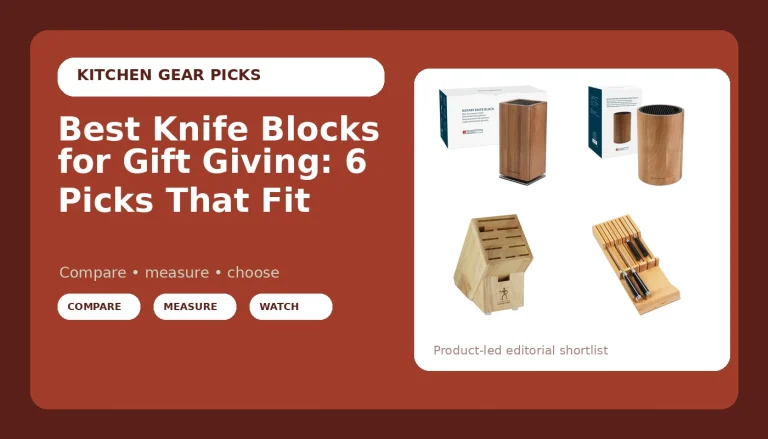
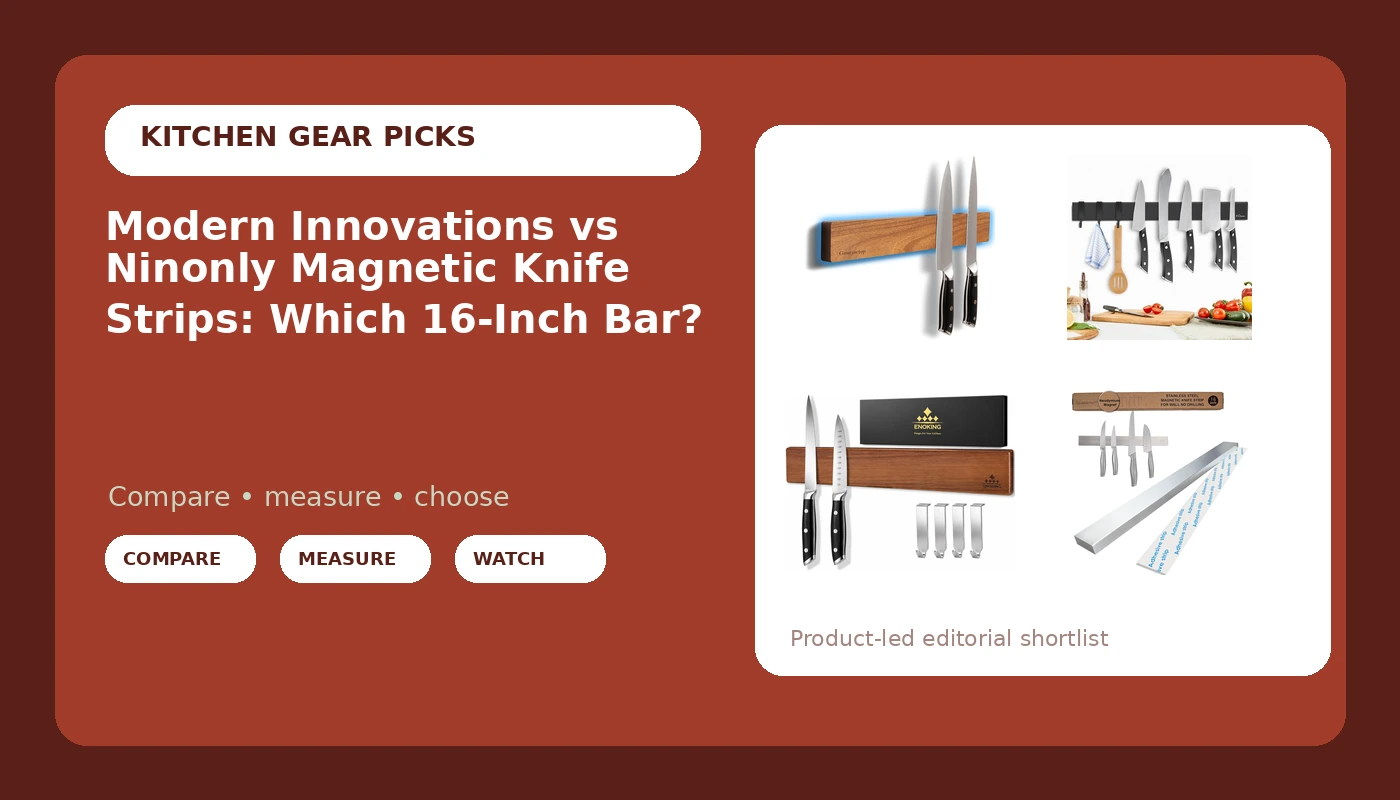
Most people who type modern innovations vs ninonly magnetic knife strips into a search bar are not really brand shopping. They are standing in a rental kitchen with a 16-inch run of wall between the outlet and the refrigerator, holding four knives and a cutting board, trying to work out which bar will hold the knives without a drill and without dropping a chef's knife onto a tile floor. The two names in that query stand in for a whole shelf of 16-inch bars that look identical in photos and differ in the three things that actually matter: what the face is made of, how it attaches, and whether it gives you hooks.
I have not had my hands on any of the four strips below, so I am not going to pretend otherwise. What I can do is read four listings line by line, hold them against what a wall-mounted strip has to do in a working kitchen, and tell you which one I would put my own knives on. That is the standard I apply to every piece of kitchen organization gear that comes through this house: show me the specification, not the adjective.
The best of the four for most kitchens is the 16-inch acacia strip with four hooks, because it gives you the most storage for the same 16 inches of wall and the wood face hides the small scuffs that steel advertises. If your wall is tile or the side of a fridge and you want the least visible hardware, the stainless strip with the adhesive tape is the more sensible second choice.
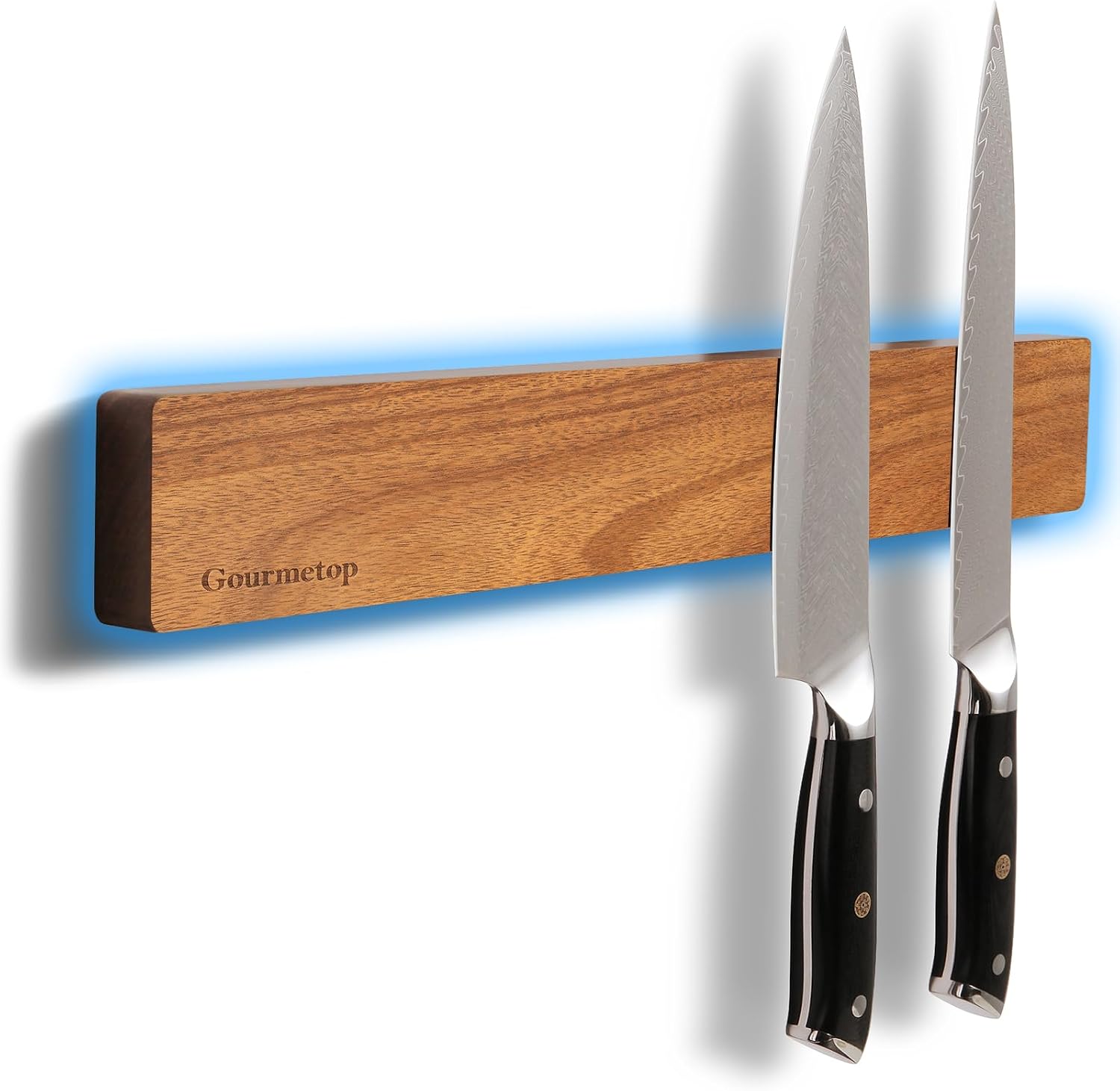
Magnetic Knife Holder for Wall 16”, Acacia Wood, No Drill Fridge
Acacia face and a no-drill mount, with the fridge side named as a target surface
No hooks in the name, so utensil storage becomes a second purchase
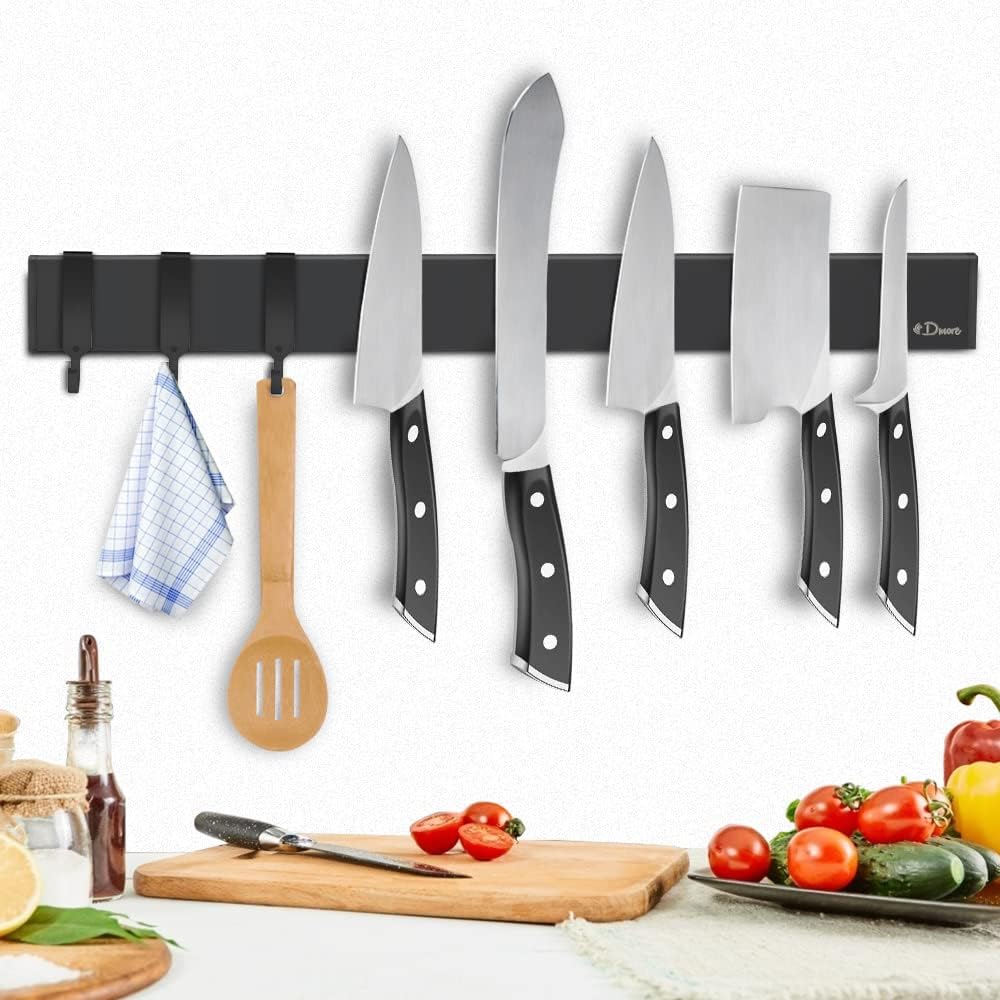
Dmore magnetic knife holder for wall with 3 hooks, No Drilling, 16 Inch
Three hooks, 16 inches, no drilling, so knives and utensils share one bar
The listing name never states the face material, so you cannot check the finish before buying
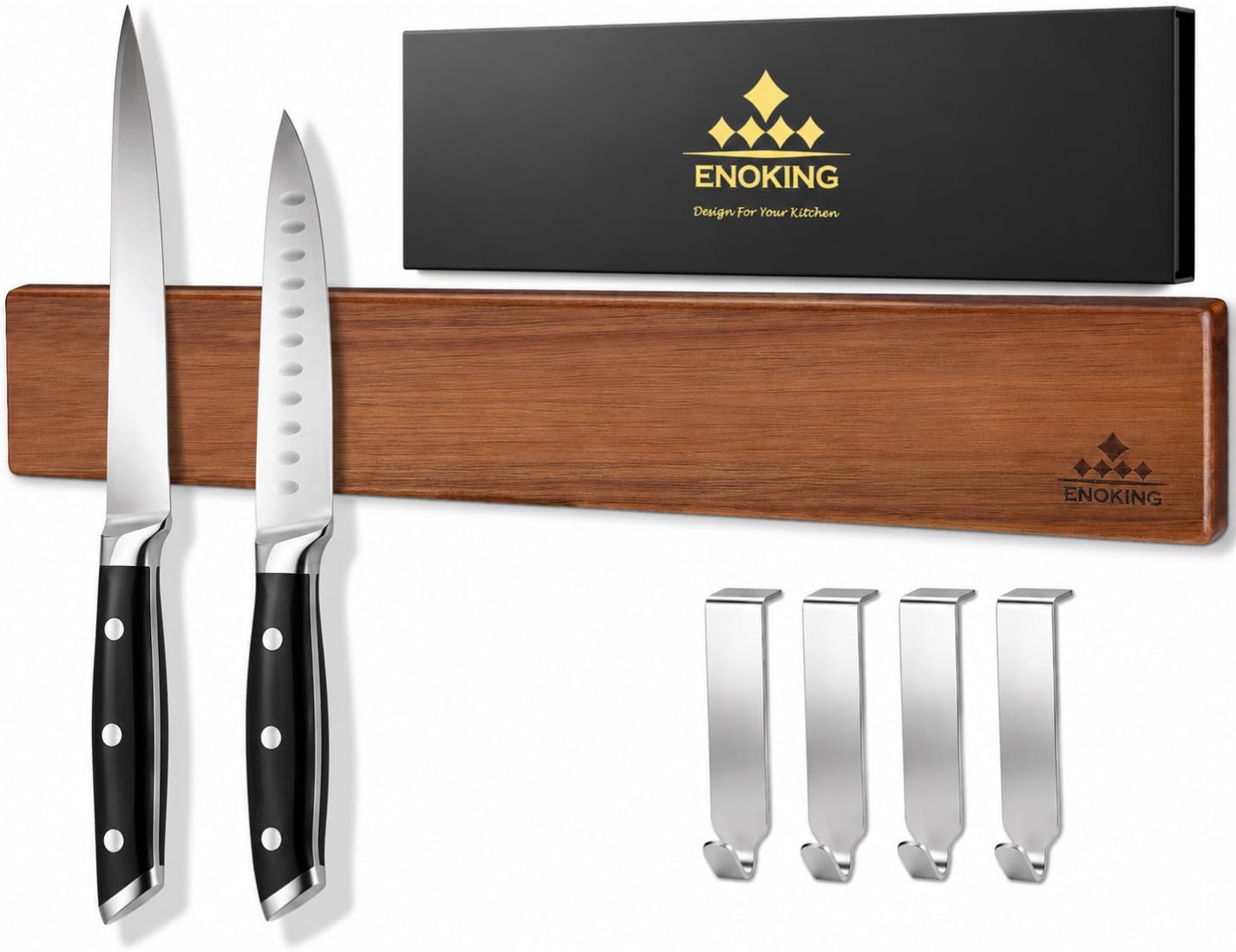
Magnetic Knife Holder for Wall, 16 Inch Acacia Wood Knife Strip, 4 Hooks
Four hooks plus acacia, the most storage per inch of wall in this group
No no-drill claim in the name, so confirm the hardware that ships in the box
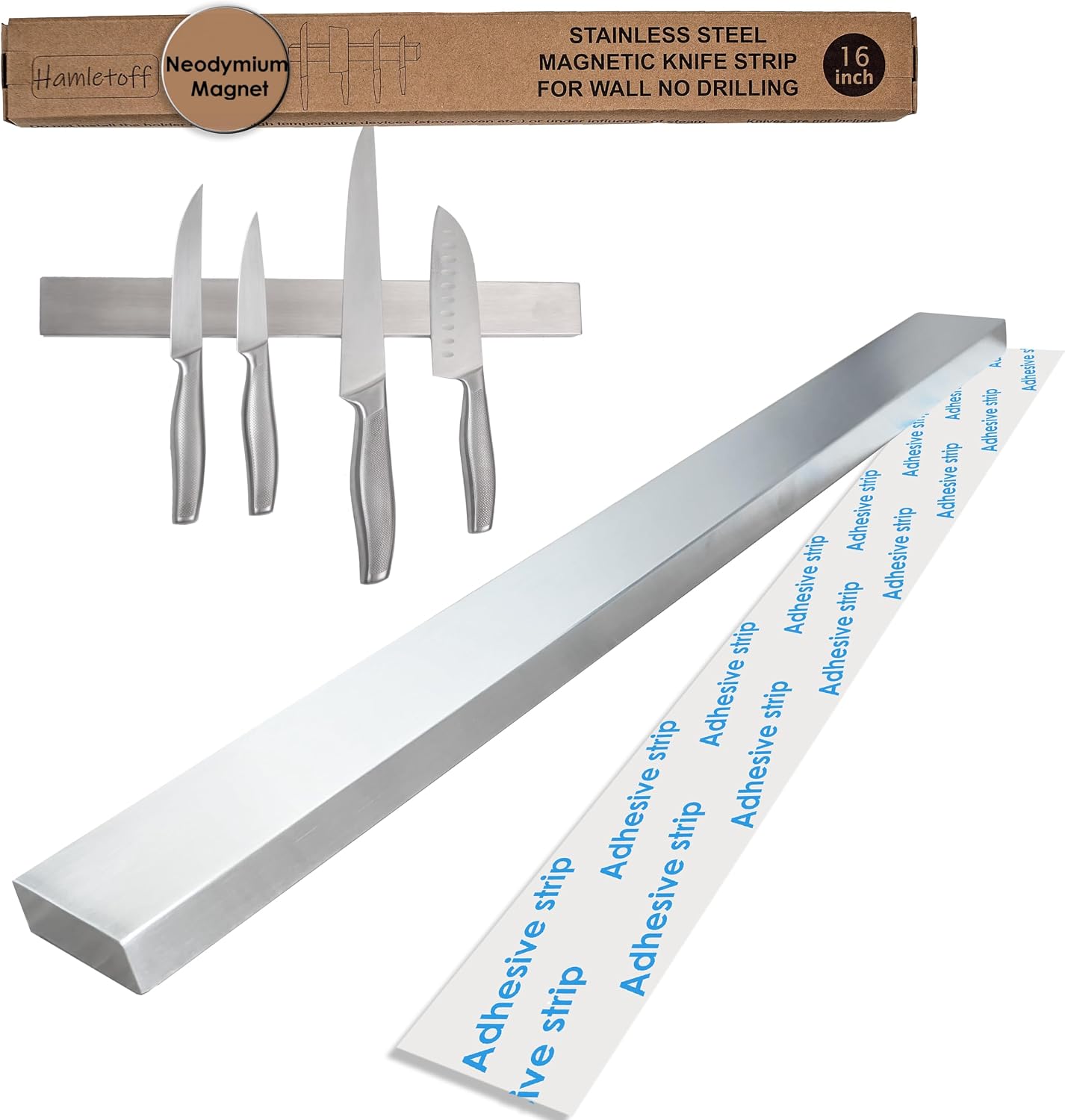
Premium Magnetic Knife Strip for Wall no Drilling, 16 Inch Stainless Steel Magnetic Knife Holder with Neodymium Magnet Strong Adhesive Tape – Lightweight Kitchen Magnet Knife Bar
Neodymium named, stainless face, adhesive tape included, light enough for tape to carry
"Premium" in the name with no magnet grade or pull force stated; steel shows every mark
Prices and availability may change.
How I judge a magnetic knife strip
Four things decide whether a strip is still on the wall in two years, and none of them is the brand name.
The first is the mounting surface. Adhesive-backed strips, which is what "no drill" means on three of these four listings, hold on smooth, non-porous, grease-free surfaces: cured painted drywall, tile, glass, the side of a refrigerator, the end panel of a cabinet. They do not hold on textured drywall, brick, or the bumpy plaster in an older house, at least not for long. If your wall has any texture you can feel with a fingernail, plan on screws or plan on a different wall.
The second is the hardware list. A strip that ships with screws and anchors can go into a stud or into drywall with the right anchors. A strip that ships only with tape has one installation path. Neither approach is better in the abstract, but you should know which one you are buying before the box arrives, because a strip that will not stick is a return you have to pack up.
The third is load capacity, and this is where 16-inch bars get oversold. How many knives a bar holds depends on blade widths, not on a number in the listing: a paring knife occupies an inch, a 10-inch chef's knife occupies most of a foot, and a cleaver takes whatever it wants. A 16-inch strip is realistically a four-to-six-knife bar for a normal mix of blades, and fewer if you also hang a honing steel. None of these four listings states a pull force, so you are trusting the magnet by omission.
The fourth is where your hand goes. Accessibility is not a marketing word here. Mount the bar so the shortest person in the house can reach the handle of the knife they use most, which usually means the bottom of the bar somewhere between shoulder and eye level for whoever does the cooking. A bar mounted high enough to be out of a child's reach is also high enough that you will grab the wrong end of a blade on a tired evening.
Countertop footprint is the entire reason to buy one of these. A magnetic strip and a knife block hold the same knives, but only one of them costs you nothing on the counter. That trade is worth making in a small kitchen and barely worth making in a large one.
Wood strips: what acacia does and does not hide
Two of these four are acacia, and that is the right wood for the job. Acacia is dense and closed-grain, which matters because a knife strip takes two kinds of wear: the blade edge tapping the face when you hang a knife carelessly, and the occasional wipe with a damp cloth. Closed grain does not drink a splash the way cheap open-pore wood does.
Wood hides scuffs. Polished stainless steel shows every one of them. That is the whole aesthetic argument, and it is a practical one too, because a bar you are not afraid to use is a bar that stays in service. A wood face also warms up a visible wall in a way that a brushed metal bar does not, which matters in a kitchen where the strip is on the open side of the room rather than tucked under a cabinet.
What wood does not do: it does not like soaking, it does not go in a dishwasher, and it will dry out and look tired if you never oil it. A drop of mineral oil twice a year is the entire maintenance routine.
The real difference between the two acacia bars is the hooks. The 16-inch acacia knife strip with four hooks states its material and its hook count in the same breath. The fridge-side acacia bar states a no-drill mount and no hooks at all. Four hooks is a functional difference, not a decorative one: hooks take the ladle, the tongs, the measuring cups, and the strainer that would otherwise live in a drawer or, worse, on the counter.
The Dmore strip is the odd one in this group because its name gives you three hooks, a no-drill mount, and a length, but no material. That is not automatically a bad sign. It is a sign that you should look at the product photos and the specification table before you buy, because a 16-inch strip with hooks could be acacia, bamboo, or a composite. In kitchen organization, face material decides how you clean the thing, and this listing is not helping you decide.
Stainless steel and the neodymium question
The stainless strip is the only one of the four whose name commits to a magnet type: neodymium. That is the strongest common magnet family used in kitchen hardware, and it is also the cheapest marketing word in the category, because nearly every decent magnetic bar uses neodymium while the grade varies wildly. Grade and pull force are the two numbers that would let you compare one bar against another. This listing gives neither.
What it does tell you is useful. 16 inches, stainless face, adhesive tape in the box, lightweight construction. Lightweight is a genuine advantage for an adhesive mount, because the tape is holding the bar plus the knives, and every extra ounce of steel is an ounce the tape has to carry for years. A heavy bar on weak tape is a knife-shaped hazard. A light bar is a much easier ask.
The cost of steel is visual. Every fingerprint, every splash of pasta water, every dusting of flour from the counter shows on a stainless face, and if the bar lives beside the stove you will be wiping it weekly. That is not a reason to avoid it. It is a reason to decide whether you want a kitchen surface you clean or a kitchen surface that forgives. Wood forgives. Steel does not.
What modern innovations vs ninonly magnetic knife strips really asks
Strip away the two brand names and that search is asking one question: wood or steel? The wood bars in this group give you a face that absorbs the small collisions of daily use, a hook set on one of them, and a warmer look on an open wall. The steel bar gives you a lighter fixture, a stated magnet family, and an easier wipe, at the cost of visible smudges. Three of the four claim a no-drill mount, so the mounting method is not what separates them.
The second question buried in that search is whether the bar is structural or decorative. A magnetic strip is structural. It holds a blade by magnet strength alone, with no lip, no clip, and no mechanical backup, and it does that above a floor where people stand barefoot. That is why I care more about magnet specification and mounting method than about finish. A pretty strip that lets go is not organizing anything.
That is the honest version of modern innovations vs ninonly magnetic knife strips: it is not a brand fight, it is a shortlist of mounting surfaces and blade counts. If you own the wall, you have every option and screws are the most secure. If you rent, the no-drill claim on three of these listings is the feature you are actually paying for, and you should test the tape on a hidden patch of wall for a day before you commit a bar and four knives to it.
Hooks, spacing, and the 16-inch footprint
Hook count is the quiet specification. One bar with four hooks can hold the knives plus the utensils that were cluttering the counter, which is the decluttering argument for this whole category in a sentence: a strip plus hooks empties a drawer. A bar with no hooks is a knife holder. A bar with three or four hooks is a wall-mounted utensil rail that also holds knives.
Spacing matters as much as count. Hooks under a 16-inch bar have to sit far enough apart to take a ladle and a whisk without tangling, and far enough from the end of the bar that the first hook is not where your hand goes when you reach for a knife. There is no adjustable fit on any of these four; the hooks are where the factory put them, so look at the photos and count the gaps rather than assuming they will suit your utensils.
The 16-inch length is the right default for a domestic kitchen. It fits between a backsplash outlet and a cabinet end, it spans the wall above a short counter run, and it holds the knives a household actually uses rather than the duplicates in a block. In a pantry layout, the same bar can hang on the wall beside the door and take the knives out of the cooking zone entirely, which is worth considering if your prep space is a single square foot.
For magnetic knife strips for college students, the constraints are harsher: a dorm wall that may be painted cinder block, a housing agreement that forbids holes, and a roommate who will overload the bar in the first week. In that setting the adhesive-only steel strip is the safer bet, mounted on the side of a mini fridge or a metal cabinet rather than on the wall, and loaded with four knives instead of six.
What the listings do not say
None of these four states a pull force. None names an adhesive brand or a cure time. None gives a weight rating, and only one names its magnet family. That silence is where the two-year prediction gets made.
The bar that fails first almost never fails at the magnet. It fails at the tape, and it fails for a boring reason: the wall was wiped with a greasy rag, or the strip was loaded the same afternoon it went up, or the wall has a texture you can feel. A few magnetic knife strip maintenance tips that actually extend the life of the thing: clean the wall with rubbing alcohol and let it dry completely before the tape goes on, wait the full cure time before hanging anything, wipe the bar with a dry cloth weekly rather than a wet one, oil a wood face twice a year, and hang knives by the spine rather than the edge so the blade does not chip on the way down.
The second thing the listings do not say is what the magnet array looks like inside the bar. A full-length array grips evenly. A couple of magnets at each end means the middle of the bar is decorative. You cannot see the array, but you can infer it from the specification table, from owner comments about knives sliding, and from a ten-minute test with your heaviest knife the day it arrives. If a cleaver will not hold at the midpoint, return the bar before the return window closes. That single test predicts more about service life than any wording on the box.
Do you need a stud finder before you buy?
For a screw-mounted bar, yes. A 16-inch strip has two or three holes, and you want at least one of them in a stud or a proper anchor. For an adhesive bar, no, but you do need a clean, smooth, room-temperature wall and one day of patience. The cheapest insurance here is a basic stud finder and a roll of painter's tape, using the tape to mock the bar up at the height you plan to mount it before anything sticks to anything.
Whether to spend more than the entry point is a fair question. In the magnetic knife strips under 100 bracket, which is where all four of these sit, the differences come down to face material, hook count, and how much the listing is willing to tell you. Paying more buys finish and hardware, not a stronger magnet, unless the listing states a grade. So buy the one whose stated specs match your wall, and put the difference toward a knife you will actually use.
What I'm watching next
I want pull force printed on the box, the way pan thickness should be printed on a pan. Until that happens, the way to judge a magnetic strip is the way I judge everything else in this kitchen: read what the listing states, notice what it omits, and assume the omission is where the compromise lives. The steel bar in this group is the one whose omission I would check first, because it leads with premium and never says what it is premium relative to. The acacia bar with four hooks is the one whose specification line already answers the questions I would ask, and that is why it gets the wall.