Type sensarte vs nutrichef crepe pans into a search bar and you get a wall of listings that all promise the same thing: a thin, even crepe that slides off the pan without a fight. What the listings do not promise is that the pan will still sit flat after a winter of Sunday breakfasts. I keep a logbook of pans that warped on me, and it has taught me to read a crepe pan listing for the things it leaves out: pan thickness, coating chemistry, how the handle is attached, and whether the maker will stand behind the cooking surface after a hundred cycles through the dishwasher.
The pick for most home kitchens in this group is the Sensarte 12 inch with the granite coating, because it gives you the widest cooking surface here and the coating type that holds its release longest in ordinary use. Diameter is the part that matters most, since a crepe sets within seconds of hitting the pan and every extra inch is spreading room you get before the batter stops moving. The rest of this comparison is about when that logic breaks, and which of the other three pans earns its cabinet space instead.
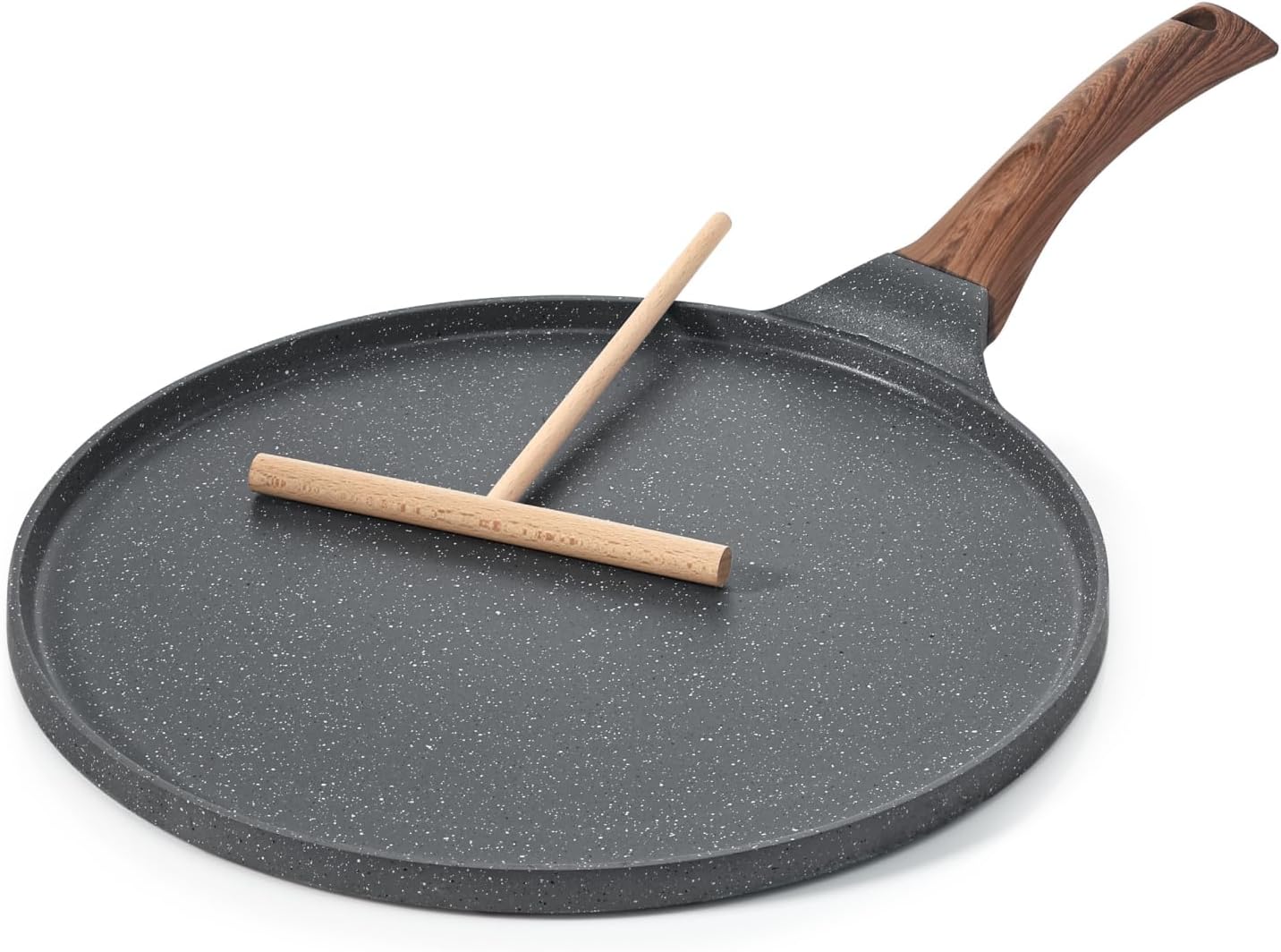
SENSARTE 12 Inch Nonstick Crepe Pan Granite Coating Pancake Pan Gray
Widest cooking surface in the group, granite coating with the best release pattern, gray finish hides polymerized oil
Needs a wide burner to heat the outer ring, largest footprint in the cabinet, no thickness spec anywhere in the listing
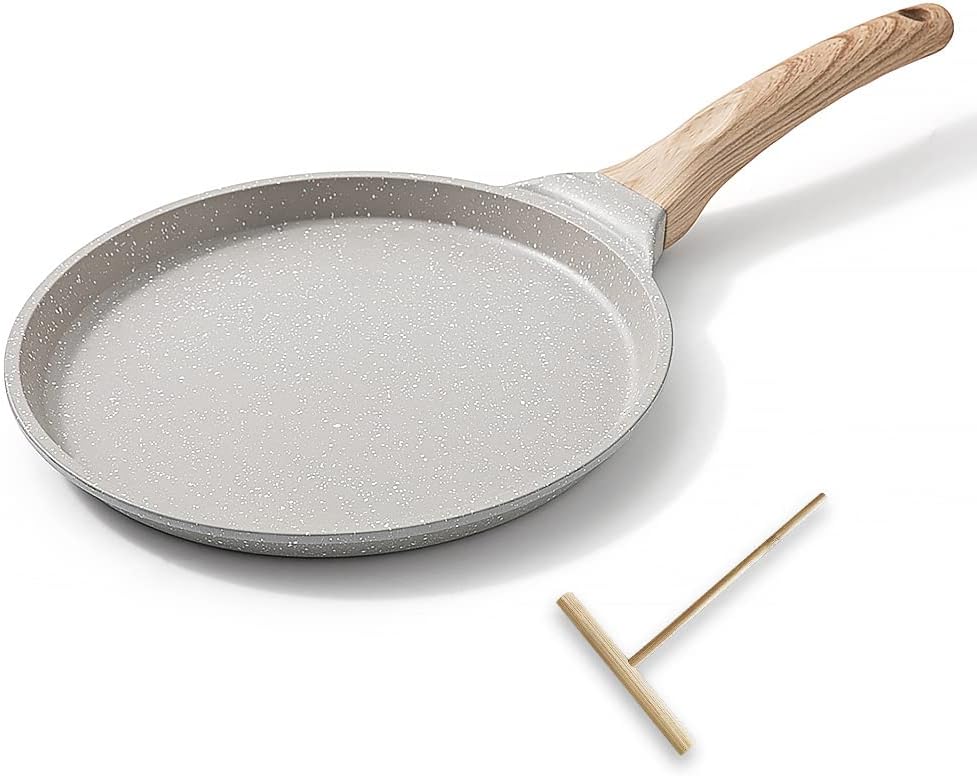
8 inch Crepe Pan, Nonstick Pan for Crepes Omelette Tortillas,White
Small enough for a single burner and a shallow drawer, doubles as an egg and omelette pan
Too small for a full crepe, so you pour twice as often, and the listing name puts no brand forward for future support
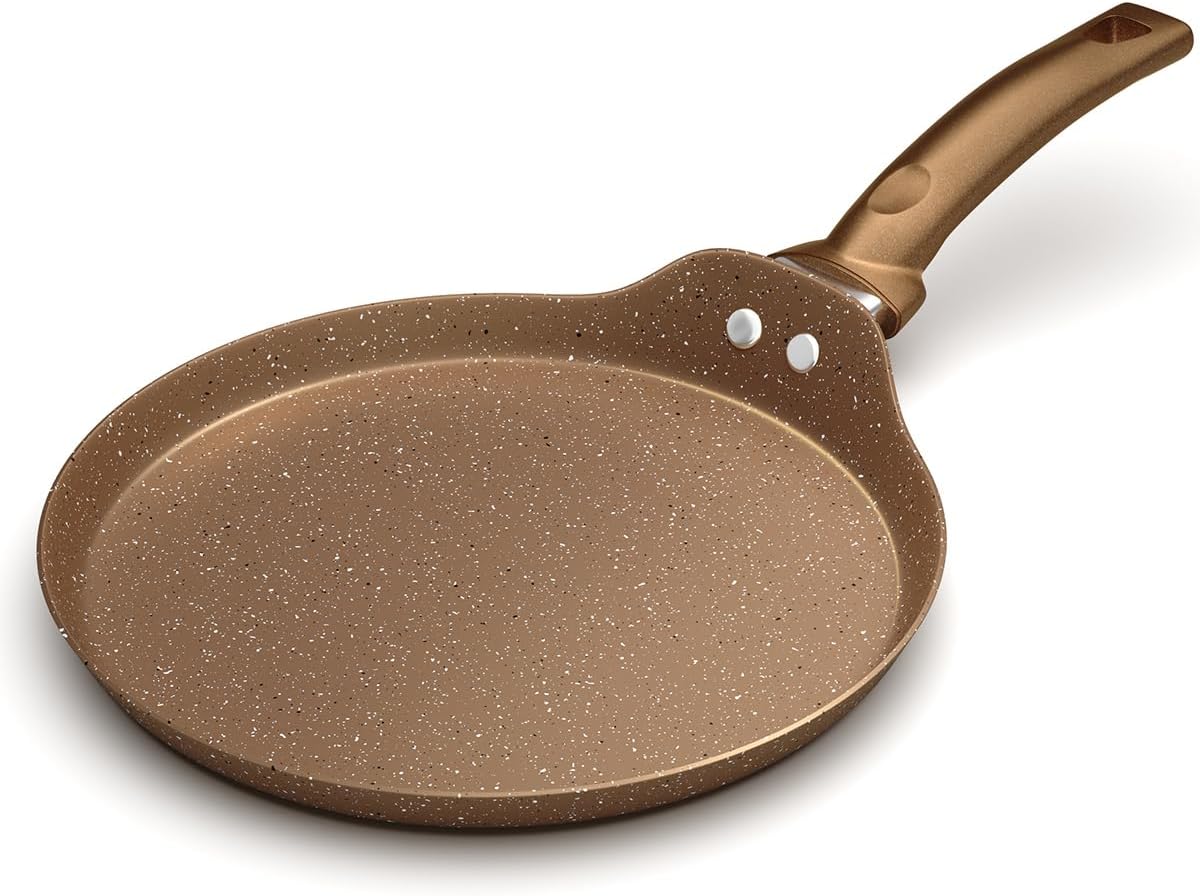
Innerwell 11 Inch Nonstick Crepe Pan,Granite Coated Pancake Pan-Gold
The size compromise that fits most home burners, granite coating, good spread for a family stack
Gold exterior shows every scorch mark, and the brand is the least established of the three here
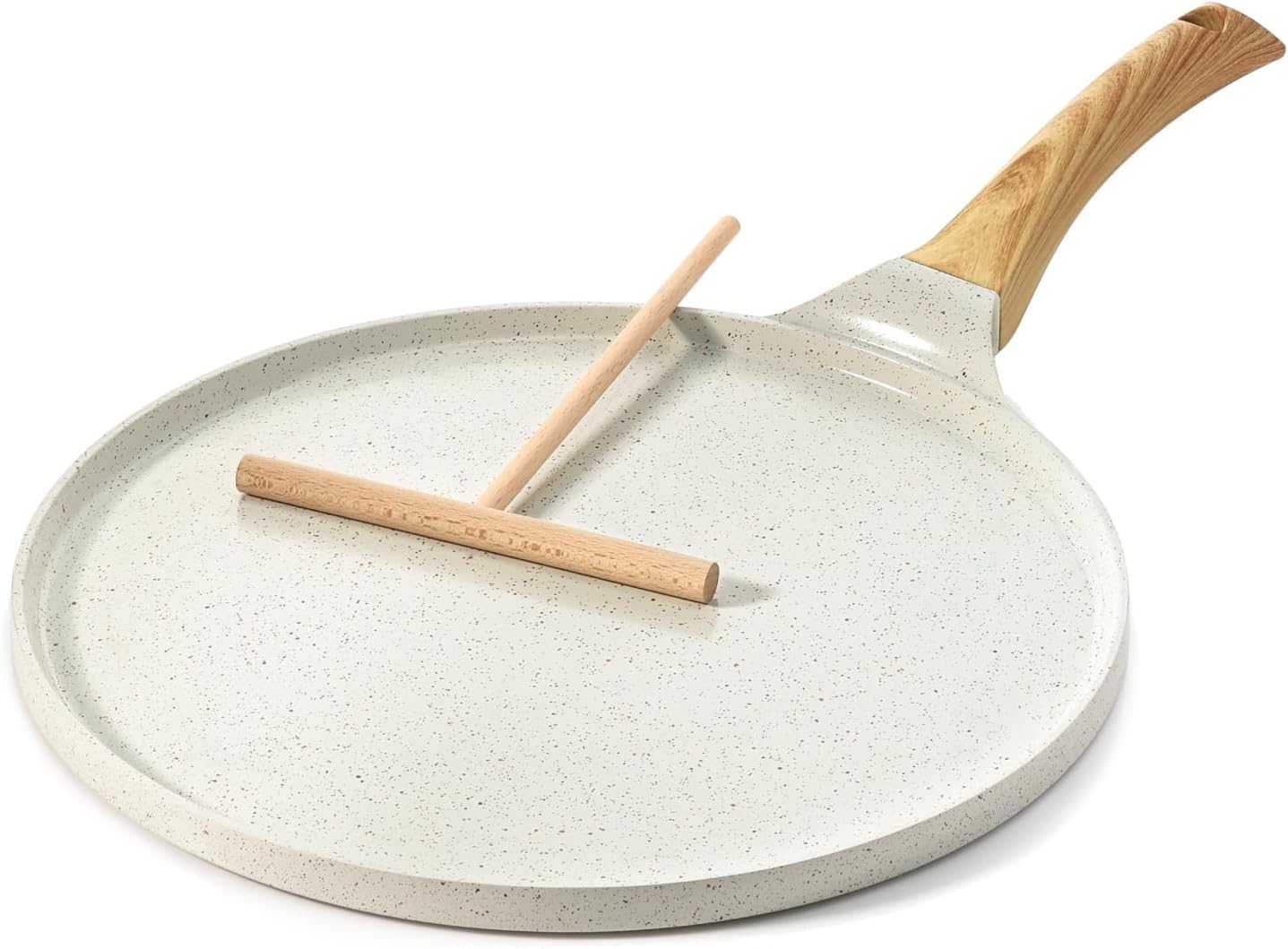
SENSARTE 12 Inch Nonstick Crepe Pan Ceramic Coating Pancake Pan White
Same 12 inch body as the gray pan, ceramic coating tolerates higher heat, white finish photographs well
Ceramic release fades faster than granite, white shows every stain, and it rewards careful heat control
Prices and availability may change.
sensarte vs nutrichef crepe pans: what is actually in this comparison
The search phrase names two brands, but the group in front of me is four pans across three sizes. Two are Sensarte 12 inchers: one with a granite coating in gray, one with a ceramic coating in white. The Innerwell is 11 inches, granite coated, with a gold finish. The fourth is an 8 inch white pan whose listing name does not put a brand forward at all, which is worth noticing. An unnamed pan is a pan you cannot look up in two years when the coating starts to go, and a pan with no parts or replacement path.
What that gives you is a cleaner experiment than the keyword suggests. Sensarte appears twice with, as far as the listings describe, the same body and two different cooking surfaces. Same diameter, same brand, different coating. That isolates the coating question. The other two pans change diameter and brand at once, so a fair comparison has to pull those variables apart instead of treating four products as one horse race.
Size first: 8, 11, or 12 inches
Crepe batter is unforgiving about pan diameter, and the geometry is the least arguable part of this whole comparison. A 12 inch pan gives you roughly 113 square inches of cooking surface. An 11 inch gives about 95. An 8 inch gives about 50. Nothing about branding changes those numbers, and they explain most of the practical difference between these four pans.
An 8 inch pan makes a crepe that fits on a dessert plate. If your household treats crepes as a weekend project with a stack in the middle of the table, 8 inches means twice as many pours, twice as many chances to tear one, and a lot of standing at the stove while everyone else eats. It is also the pan that fits a small burner and slides into a crowded cabinet, which is not nothing in a kitchen with 42 square feet of counter and four people who all want lunch at once.
Twelve inches is the size that behaves like the crepe pans you see at a market stand. You get a thin spread in a single pour and a crepe you can fold around a serious filling. The catch is heat: a 12 inch pan needs a burner wide enough to heat the outer ring, or you get a pale rim and a dark center. On an 8 inch electric coil, the 12 inch Sensarte pans will frustrate you before the coating ever does.
The 11 inch Innerwell sits in the slot most home kitchens can actually use. It covers the middle of a 9 inch burner, it still spreads a full-size crepe, and it leaves room on the stove for a second pan. If you have never owned a crepe pan and you are not sure where you land, this is the dimension that argues with nobody.
Coating: granite against ceramic
Granite coating is a marketing name for a PTFE based nonstick surface with stone particles added for texture and color. Ceramic coating is a silica based finish, usually sprayed and cured. The general pattern in nonstick cookware, across brands and price bands, is that PTFE based surfaces release better and keep releasing longer, while ceramic surfaces tolerate higher heat and lose their release faster, often within months of regular use.
That is not a knock on the Sensarte ceramic 12 inch. It is a description of what you are buying with it. The white ceramic pan is a pleasure when you keep the heat moderate, use a silicone or wooden spreader, and never let it go dry on a hot burner. If your morning style is a rushed preheat while you answer a text, the granite gray pan is the more forgiving surface. Visit on Amazon
Seasoning is not part of the deal with any of these four. Seasoning is for carbon steel and cast iron, where oil polymerizes into the metal and becomes the release layer. Nonstick cookware arrives with its release layer already applied by the factory, and the only maintenance it wants is gentle heat, soft tools, and a wash that does not involve scouring. Anyone who tells you to season a coated crepe pan is telling you to build a sticky film on top of a surface that did not need one.
The finishes matter more than the listings admit. Gray hides polymerized oil and browned butter splatter. White shows every stain, including the faint tan ring where batter sat too long. Gold shows scorch marks on the outside even when the cooking surface is fine. If you care how the pan looks on the shelf, buy accordingly, because all three will discolor with use.
What crepe pan thickness tells you before you buy
None of the four names in this comparison carries a thickness figure, and that is the first number I go looking for. Pan thickness is the spec that predicts whether the pan is still flat in two years, because a thin aluminum body flexes under heat and a flexing body is the first step toward a permanent warp. When a listing will not state a millimetre figure, assume the thin end of the range and treat the pan as a two year item rather than a ten year one.
The practical translation for a crepe pan is simple. Thin bodies heat fast and respond quickly, which is genuinely useful when you are adjusting a burner between crepes. Thick bodies heat more evenly and resist the oil-canning that makes batter pool at one edge. There is no free version of either. A fast pan is a pan you have to watch, and a steady pan is one that takes longer to come up to temperature on the first crepe of the morning.
Two other details belong in the same conversation. First, base flatness out of the box: set the pan on a stone counter and press a corner. Any rock now becomes a wobble on a hot burner later. Second, induction compatibility, which none of these four names mentions. If your range is induction, verify that before you order, because a pan that will not couple with the burner is a trivet with a handle.
Heat distribution, warping, and thermal shock
A crepe pan spends its life being heated dry, which is the harshest treatment in a home kitchen. Aluminum spreads heat well, but a wide pan on a narrow burner concentrates it in the middle, and the temperature difference between the center and the rim is where warping starts. My rule for all four of these pans is the same: preheat on medium, give it three full minutes, and let the first crepe tell you whether the pan is ready.
Thermal shock is the other destroyer, and it is entirely preventable. A hot pan hit with cold water can dish its base in seconds, and the damage does not come back. Let the pan cool on the stove while you eat. The same logic applies to the refrigerator and the freezer. A coated pan that goes from a 400F oven to a cold sink is a pan you have decided to replace.
This is where my bias shows. A pan that warps at 450F is not a bargain at any price, no matter how well it releases on day one. If any of these four develops a wobble, no amount of careful spatula work will fix the way batter runs to the low side. Treat heat control as the real purchase decision and the brand name as the last thing on the list.
Handles, oven safe claims, and the dishwasher safe question
Look at how the handle meets the body, because that joint decides whether the pan outlives its coating. Riveted handles are held by metal that goes through the pan wall. Spot welded handles are attached at two or three points on the surface. Both work, but rivets tolerate more weight and more years of a full pan being lifted at an angle. A loose handle is the second most common failure after coating wear, and it is the one that burns people.
Oven safe is a phrase to read carefully. The limiting factor is rarely the handle. It is the coating, which has a temperature ceiling well below what a broiler produces. A pan rated oven safe to 450F is not a pan you put under a broiler, and no crepe recipe needs the broiler anyway. If you plan to finish a thick pancake or a Dutch baby in the oven, check the coating rating and keep the rack in the middle.
Dishwasher safe deserves the same skepticism. Hot water and detergent attack the edge of any coating, and the spray arm is not gentle. Even where a listing says dishwasher safe, I treat that claim as a promise about the handle and the exterior, not the cooking surface. Hand washing a crepe pan takes about twenty seconds with a soft sponge and warm water. That twenty seconds is the cheapest insurance in the kitchen.
Why a crepe pan for restaurant kitchens is a different tool
Search for a crepe pan for restaurant kitchens and you will find home cook listings borrowing commercial credibility. I do not write about commercial kitchen equipment, and I would not pretend these four pans belong on a service line. A restaurant crepe station runs on thick carbon steel or a seasoned cast plate, heated hard and scraped clean dozens of times an hour. No coated surface survives that schedule.
What you can borrow from that world is the workflow. A thin spreader, a steady medium heat, and a rest period for the batter so the flour hydrates. Those three habits matter more than the pan, and they cost nothing. If your actual requirement is a pan that survives a high output morning, the honest answer is a carbon steel crepe pan and a proper seasoning routine, not a nonstick one.
For a home kitchen making crepes twice a month, the calculation flips. Nonstick release is worth more than durability, because you will not put in the hours that make carbon steel pay off, and you will not want to babysit the seasoning on a Tuesday. Buy the coated pan, use soft tools, and replace it when the surface stops releasing. Nonstick is a consumable, not an investment, and pretending otherwise is how people end up angry at a pan that did exactly what it was built to do.
The best crepe pan for meal prep might be the 11 inch
The best crepe pan for meal prep is the one that keeps working after the crepes are done, and that argument favors the Innerwell 11 inch. A pan in this size range handles a two egg omelette, a stack of tortillas warmed one at a time, a batch of scallion pancakes, and a quick reheat of a folded crepe straight from the freezer. It fits a standard burner and it fits a cabinet shelf without becoming a dedicated unitasker.
Meal prep logic also favors the wider Sensarte pans if you are cooking in volume. A dozen crepes go faster on 12 inches, and the cooling stack in the middle of the table gets taller before the batter bowl is empty. The trade is storage and burner width. If your stove has one large burner and three small ones, the 12 inch pan will spend its life on the one hot spot, which is fine, as long as you accept that.
The 8 inch white pan is the counterargument to all of that. It is a single serving pan: one crepe, one fried egg, one small tortilla. If you cook for one or two people and you have a drawer rather than a cabinet, that small footprint is the feature. Visit on Amazon Just do not buy it expecting to feed four people before the coffee goes cold.
Which pan I would buy, and which I would skip
The sensarte vs nutrichef crepe pans question does not have a single answer, and any page that gives you one is selling something. What it has is a decision order. Pick your diameter first, because that determines how many pours your Sunday takes and whether the pan fits your burner. Pick your coating second, because that determines how long the pan keeps releasing. Ignore brand prestige entirely, because at this level of the market it predicts the marketing budget, not the cooking surface.
My order: the Sensarte 12 inch granite in gray for a household that makes crepes often and has a wide burner. The Innerwell 11 inch granite for a household that wants one pan to cover crepes, eggs, and tortillas on a normal stove. The Sensarte 12 inch ceramic in white for someone who keeps heat moderate, likes the look, and accepts that the release layer has a shorter clock. The 8 inch white pan for a small kitchen cooking for one or two, with the understanding that it is a specialist.
Two pans I would skip. A 12 inch pan on a small burner, because heat distribution will disappoint you and you will blame the coating. And any of the four if the listing will not give you a thickness figure and a heat rating, because that silence is usually the answer to your question. Visit on Amazon
If you want the short version to carry into the store: 11 or 12 inches, granite if you want the longest release, ceramic if you want the higher heat ceiling and a white finish, and a soft spreader no matter what you choose. Then learn your burner. Heat control matters more than the name on the handle, and it is the only part of this comparison you can change after the box is open.